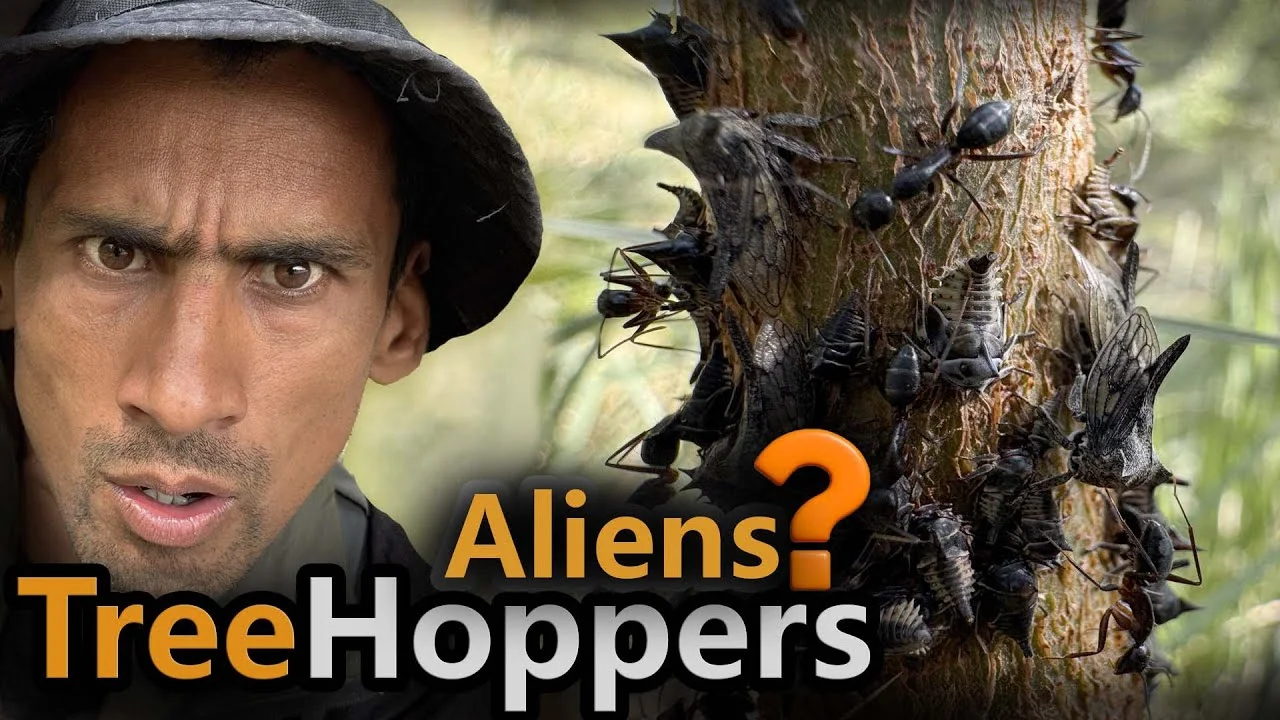
Treehoppers Uncovered: Identification, Behavior, Ant Mutualism & Ecological Role in Pakistan’s Wild Landscapes
Introduction: The Hidden Aliens of Our Jungles:
For millions of years, some of the most extraordinary insects have lived quietly around us—unnoticed, unexplored, and misunderstood. Among them are Treehoppers, often described as “living aliens” because of their bizarre shapes and secretive lifestyles.
Today, we begin uncovering these fascinating creatures found in Pakistan’s jungles, agricultural zones, and forested regions, guiding you through their behavior, camouflage, feeding systems, and one of nature’s strongest partnerships: ant mutualism.
This exploration is led by Abdul-Rehman (The Venom Boy) and the mission of WildRushPK, dedicated to promoting awareness and conservation of Pakistan’s wildlife.
What Are Treehoppers & How to Identify Them:
Treehoppers belong to the insect family Membracidae. They are small plant-feeding insects, typically measuring 5 mm to 12 mm in length.
Key identification features include:
-
A distinct pronotum (an enlarged structure extending over the head and body)
-
Fully developed wings in adults
-
Strong hind legs adapted for jumping
In Pakistan, Treehoppers are commonly observed on tree branches, shrubs, and crop plants, particularly during warmer months.
Unbelievable Pronotum Shapes: Nature’s Living Sculptures:
The pronotum is what makes Treehoppers truly unique. Across the world—and including South Asian species—it can resemble:
-
Horns and spines
-
Leaves and thorns
-
Tent-like or helmet-shaped structures
These shapes act as camouflage, helping Treehoppers blend into branches and avoid predators such as birds and lizards commonly found in Pakistan’s ecosystems.
Global Distribution & Presence in Pakistan:
Treehoppers are found across:
-
Asia
-
Africa
-
South America
In Pakistan, they thrive in:
-
Forested areas
-
Rural farmlands
-
Orchards and agricultural zones
Their ability to adapt to both wild and cultivated plants explains their widespread presence.
Feeding Behavior: Xylem Sap & Honeydew Production:
Treehoppers feed on xylem sap, a fluid transported within plants that contains water, minerals, and nutrients absorbed from the soil.
How They Feed
-
They insert a tubular mouthpart called a proboscis into plant tissue
-
Sap flows upward through the plant due to transpiration pressure
-
Excess fluid is expelled as honeydew (a sweet, sugary substance)
Mutualism With Ants: One of Nature’s Strongest Partnerships:
Treehoppers share a powerful mutual relationship with ants:
-
Treehoppers provide honeydew as food
-
Ants offer protection from predators and parasites
This interaction is commonly observed in Pakistan, where ants, Treehoppers, and even other insects coexist on the same branches in large numbers.
Reproduction, Egg Laying & Maternal Care:
Unlike many insects, some Treehopper species display maternal guarding behavior:
-
Females lay eggs on plant stems
-
Mothers stay nearby to protect eggs and nymphs from predators
-
This behavior significantly increases survival rates
Nymph Development & Group Living:
Treehopper life stages include:
-
Egg
-
Nymph
-
Adult
Nymphs:
-
Lack horns and fully developed wings
-
Often live in groups
-
Rely on adults and ants for protection
Group living is common in Pakistan’s warm environments, where survival depends on cooperation.
Communication Through Plant Vibrations:
Treehoppers do not communicate using audible sound. Instead, they:
-
Produce vibrational signals
-
Transmit messages through plant stems and branches
-
Warn others of danger or coordinate group movement
These signals are undetectable to humans but highly effective within their species.
Defense Behavior:
When threatened:
-
Treehoppers jump using strong hind legs
-
Entire groups may disperse or react simultaneously
-
Ants often attack intruders as part of mutual defense
Ecological Importance in Forests & Food Webs:
Treehoppers play an essential role in ecosystems:
-
Support ant populations through honeydew
-
Serve as food for birds, reptiles, and insects
-
Influence plant health and nutrient flow
Their presence indicates a balanced ecosystem, particularly in forest and rural environments of Pakistan.
Are Treehoppers Pests or Beneficial Insects?
Treehoppers can be both:
-
Pests, when large populations weaken plants or dry branches
-
Beneficial, as contributors to biodiversity and food chains
In natural forests, they are mostly beneficial. In agriculture, their impact depends on population size and plant type.
Rare & Amazing Facts:
-
Over 3,200 species of Treehoppers are known worldwide
-
Some species mimic thorns so perfectly that predators avoid them entirely
-
Maternal care among Treehoppers is rare in insects
-
Their camouflage is considered one of the most advanced in nature
Conclusion: Be Wild With WildRushPK
Treehoppers may be small, but their role in nature is enormous. From bizarre body designs to complex partnerships with ants, they represent the hidden brilliance of Pakistan’s wildlife, including their part to wildlife and environment. As we also discussed their life span and life feature in this article for the readers.
Because wildlife is not just something we observe—it is something we must understand and protect.