Rescue Mission of an Indian Softshell Turtle: A Step Toward Wildlife Conservation
Early in the morning, I received a rescue call that immediately caught my attention. A large Indian softshell turtle had been spotted in a canal near a village area. People were scared, confused, and unsure of what to do. In Pakistan, especially in rural areas, wildlife encounters often turn dangerous—not because animals are harmful, but because of galt fehmi (misconceptions).
This turtle, locally known by people as Nile Sonia Ganga Tikka, is often misunderstood. Many believe it has a chhuri jaisa blade that can hurt humans. Some even think it is zehreela (poisonous). These beliefs are completely wrong. Sadly, during winters when canals dry up or water levels go down, these turtles become exposed, and fear leads people to throw stones or even kill them. My goal was clear—not only to rescue the turtle, but also to explain to people why such animals are Allah ki makhlooq and why they matter.
Journey to the Rescue Site
After the call, I headed toward the village. The location was deep inside rural land where Google Maps bhi kaam nahi karta. I had to depend on local people for directions—idhar se seedha jao, phir kachay raaste se left lena. We stayed in touch on phone calls, sharing updates about the road. The total distance was around 40–45 kilometers, but reaching there felt longer because of the rough terrain.
Condition of the Turtle
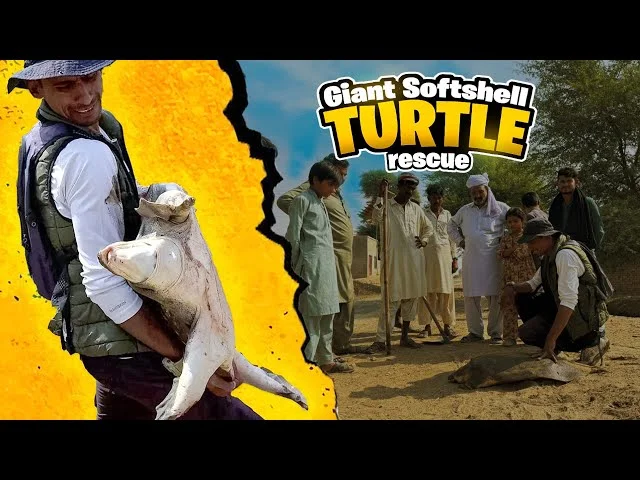
When I finally reached the site, I saw the Indian softshell turtle lying near the canal. It was huge, weighing around 38 to 40 kilograms. The turtle had clear injury marks on its mouth, likely from a fishing hook. Unfortunately, people had also thrown stones at it out of fear. I explained calmly that its shell is made of keratin. While strong, if it cracks or gets damaged, usko theek hone mein bohat waqt lagta hai.
I told the gathered villagers, “Yeh turtle kisi ko nuksaan nahi pohanchata. Yeh hamara dushman nahi hai.” Slowly, people started listening.
Awareness and Education Among Locals
I spoke to the locals in simple Punjabi and Urdu so everyone could understand. I explained that this turtle feeds on dead animals and waste in water. In simple words, yeh pani saaf karta hai. It is nature’s cleaner. Without such species, our canals and rivers would become more polluted.
Children stood close, watching carefully. I told them gently, “Pathar mat mara karo. Agar dobara aisa jaanwar dikhe, apnay baron ko batao ya rescue walon ko call karo.” These small conversations matter. Awareness at a young age builds respect for wildlife.
In Pakistan and India, this species is found only in natural water bodies like rivers and canals. Losing it would mean damaging the entire ecosystem.
Release into Natural Habitat
After ensuring the turtle was free from the hook and stable, it was time to release it. We chose a wide, flowing canal—its natural home. As I released the turtle back into the water, I quietly thanked Allah for giving it another chance at life. I prayed, “Ya Allah, is makhlooq ko hamesha mehfooz rakhna, aur insano ke haathon se door rakhna.”
Watching it swim away was a moment of pure relief and happiness. That smile was not just mine—it belonged to everyone who understood that saving wildlife is sawab ka kaam.
Conclusion
This rescue mission reminded me that wildlife conservation is not only about saving animals—it is about changing mindsets. Turtles are not dangerous; they are beneficial. Every creature has a role in maintaining balance in nature. When people understand this, fear turns into protection.
Instead of reacting with violence, we must respond with knowledge. If we protect wildlife today, we protect our environment, our water, and our future generations. Saving one turtle may seem small, but educating a community creates lasting change.
Wildlife is not separate from us—it is part of our life, our land, and our responsibility.